TL;DR
MERV 11 is the best default for a 15x25x1, capturing 65% or more of 1–3 micron particles without the pressure penalty MERV 13 imposes on 2.47 square feet of face in a 1-inch slot. Move up to MERV 13 for allergies, asthma, or smoke, but only with blower headroom and a 45 to 60 day interval. Stay at MERV 8 if static pressure is already high.
Most filter guides run their examples on a 16x25 or a 20x25 and let the 15x25 inherit the answer. That gap is wide enough to flip the recommendation on a 3-ton system, which is why every figure below was calculated for this size specifically.
Key Takeaways
• A 15x25x1 measures 14.5 x 24.5 x 0.75 inches actual, or about 2.47 square feet of face: 6% less than a 16x25x1 and 25% less than a 20x25x1.
• DOE caps residential face velocity at 500 FPM and prefers 200 to 400. A 15x25x1 crosses 400 near 2.5 tons.
• Per the EPA, MERV 8 captures ≥70% of 3–10 micron particles, MERV 11 adds ≥65% of 1–3 micron, and MERV 13 adds ≥50% of 0.3–1.0 micron.
• Depth drives resistance more than MERV does. DOE measures a 1-inch filter at 0.20 in. w.c. at 300 FPM against 0.12 for a 4-inch.
• The filter takes 20 to 50% of a system's 0.4 to 0.5 in. w.c. pressure budget.
Why Face Area Changes the MERV Decision on This Size
MERV tells you what a filter catches, and face area tells you how hard the blower works to pull air through it. On a return this small, those turn out to be the same question.
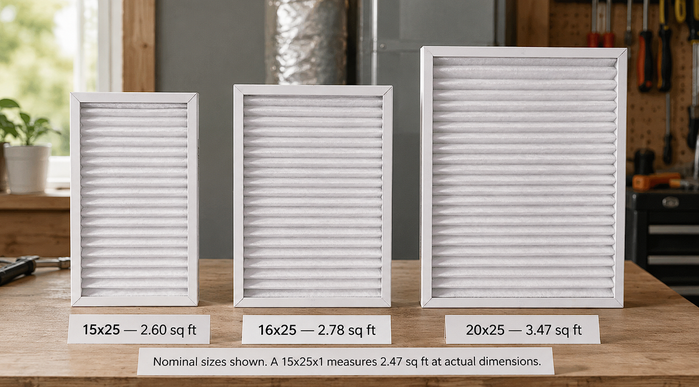
Start with the fact that a 15x25x1 is not actually 15 by 25 inches. Filterbuy, the Talladega, Alabama air filter manufacturer that produces pleated residential HVAC filters in more than 600 sizes, lists the actual dimensions as 14.5 x 24.5 x 0.75 inches and stocks the size in MERV 8, MERV 11, and MERV 13. That leaves 2.47 square feet of media, where a 16x25 gives you 2.78 and a 20x25 gives you 3.47. The depth is identical and the math is not. If you are still working out which filter type your system takes, settle that first.
How Fast Is Air Moving Through Your 15x25x1?
Face velocity is airflow in CFM divided by face area, and no number predicts the cost of a MERV upgrade better. DOE's Building America Solution Center caps it at 500 FPM and prefers 200 to 400. Run a 15x25x1 at 400 CFM per ton and a 2-ton system sits around 324 FPM, 2.5 tons around 405, 3 tons around 486, and 3.5 tons around 567, over the ceiling before you have chosen a filter at all. Building scientist Allison Bailes sets a stricter target of 2 square feet per 400 CFM, a mark this size hits at 490 CFM. All of that assumes one return. Two returns splitting a 3-ton load push 600 CFM through each, dropping the same filter to roughly 243 FPM, so find every filter location before you calculate.
Where to Find Your Tonnage and Your CFM
The two inputs to a 15x25x1 face velocity calculation are printed on equipment you already own. Tonnage lives in the outdoor condenser's model number, in digits giving capacity in thousands of BTU per hour. Divide by 12: 024 is 2 tons, 030 is 2.5, 036 is 3, 042 is 3.5, 048 is 4. On a mismatched pair, use the smaller.
CFM per ton is where most filter advice quietly overstates the problem. That 400 figure is a design convention rather than a measurement of your system, since blower speed is set by a tap or a dip switch and humid climates are often commissioned nearer 350. Rerun the 3-ton case at 350 and a 15x25x1 lands at 425 FPM instead of 486, which moves MERV 13 from off the table to worth discussing. Run both figures and read them together. Under 400 FPM either way you have room, over 500 either way you have a duct sizing problem no rating will solve, and anything in between is your signal to stop calculating and measure.
15x25x1 MERV 8 vs MERV 11: What Actually Changes?
MERV 11 is the better buy here, and what it buys you is a whole particle range. Per the EPA's MERV rating table, MERV 8 catches at least 70% of 3–10 micron particles but only 20% of the 1–3 micron band, while MERV 11 lifts that middle band to 65% and adds a 20% floor at 0.3–1.0 micron. In practice that separates a filter which keeps your coil clean from one that also pulls pet dander, fine pollen, mold spores, and dust mite debris out of the air. One caution while comparing boxes on a shelf: FPR and MPR are proprietary, so cross-brand comparison only works in MERV.
Does MERV 13 Restrict Airflow in a 1-Inch Filter?
Yes. On a 15x25x1, MERV 13 costs measurable static pressure, though depth and face velocity account for more of the penalty than the MERV number does. DOE puts a 1-inch filter at 0.20 in. w.c. at 300 FPM against 0.12 for a 4-inch, which means a deep MERV 13 can flow better than a thin MERV 8. On a 15x25x1 you control neither variable.
Context cuts both ways. Most systems are designed around 0.4 to 0.5 in. w.c. of total static, and the filter takes 20 to 50% of that budget. The EPA's Guide to Air Cleaners in the Home still finds most systems can accommodate MERV 13 provided the filter is replaced frequently, and on a return this small that proviso does most of the work. How the penalty reaches you depends on the motor. A PSC cannot change speed, so rising pressure cuts airflow, which DOE calls fall off, while an ECM holds target CFM and charges you in watts instead.
What This Looks Like on a Real System
The homeowners who call me about a 15x25x1 rarely call on day one. They call about weak airflow six or seven weeks after a MERV 13 upgrade, once the filter that went in clean has loaded up and started to bite. That timing is the whole argument for treating the replacement interval as part of the filter choice rather than an afterthought.
What's the Best MERV Rating for a 15x25x1 Air Filter?
Match the rating to your system's headroom rather than the highest number on the shelf. The order I work through with homeowners is how many returns feed the system, what blower is in it, and whether anyone in the house has a respiratory reason to push higher.
The number on the box is the easiest part of this decision and the least important one. I would rather see a homeowner on a 15x25x1 run MERV 11 and actually change it every 60 days than run MERV 13 and forget about it until the house stops cooling. On a return this small, the replacement schedule is the filtration strategy.
• MERV 8. Right if a technician has flagged high static pressure, if the return ductwork is undersized, or if this is the only return on a 3-ton or larger system. A MERV 8 that moves design airflow beats a MERV 13 that cannot.
• MERV 11. The default here, and the choice to make if you are not going to measure anything.
• MERV 13. Worth it for allergy or asthma sufferers, for wildfire smoke, or with an ECM that has headroom to spare. The EPA recommends MERV 13 or as high a rating as the fan and slot allow, and on a 1-inch filter the second half is what matters.
Because Filterbuy stocks the 15x25x1 in all three ratings, you can commit to one for a season and step back down if the system objects. Run that test in summer, when the blower works longest and a restriction has time to show itself.
What About a 15x25x1 Allergy Air Filter?
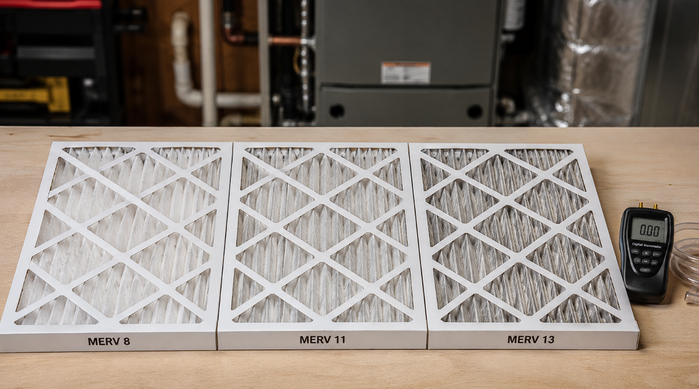
The band that matters for allergies is 1–3 microns, covering dust mite allergen, dander fragments, and most mold spores. MERV 11 is rated at 65% or better there and MERV 13 at 85%. Pollen is mostly larger and MERV 8 already handles it, which is why seasonal pollen sufferers often see less improvement from an upgrade than they expected. The other half of the answer is timing. The EPA notes that manufacturers typically recommend 60 to 90 days, shortened if filters come out heavily soiled. A loaded high-MERV filter restricts more than a clean lower-MERV one, so a MERV 13 left a full 90 days here can spend its last month choking the system.
What a Higher MERV Will Not Fix
Some MERV upgrade money goes toward problems no rating can touch. Odors and VOCs pass straight through, since MERV rates particle capture and nothing else. Return duct leakage feeds attic or garage air into the system through gaps the filter never sees. A dirty coil stays dirty after an upgrade, and it restricts airflow much the way a loaded filter does.
Smoke deserves a calibration rather than a warning. The EPA recommends a MERV 13 filter to catch the very small particles in wildfire smoke, and its own chamber testing found that air cleaners with dirty filters were almost completely ineffective, which is the replacement interval argument again in harsher terms. A MERV 13 in the return helps during a smoke event, but it will not do the job of a portable air cleaner in the room where people are sitting.
How Do You Confirm Your MERV Choice Isn't Hurting Airflow?
Measuring beats guessing, and the check takes a technician about fifteen minutes.
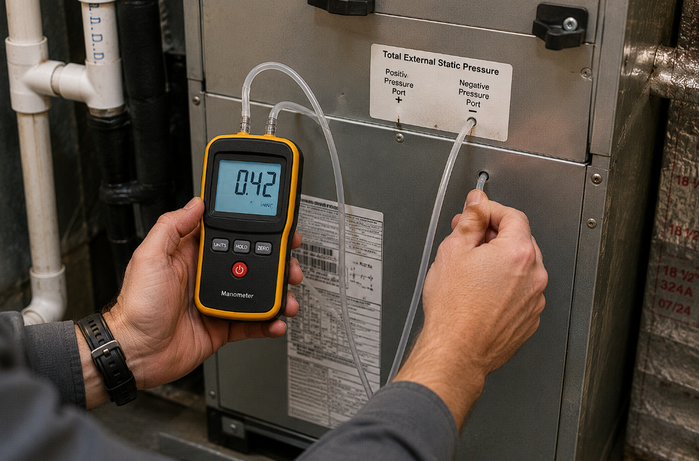
1. Find the rating. Total external static pressure is printed on the air handler's data plate, usually 0.50 in. w.c.
2. Read the system. Measure the supply side against ambient house pressure, measure the return the same way, and add the two. DOE puts the ceiling at 0.4 to 0.5 in. w.c.
3. Compare, then read again after the swap. At or above the rating with a clean filter in place, you have no headroom and MERV 13 is off the table. The difference between readings is your filter's real pressure drop.
4. Watch for symptoms. Weak supply airflow, longer run cycles, a whistling return grille, or ice on the refrigerant line are worth ruling out before you assume the AC itself is failing.
If you have headroom and want more filtration than a 1-inch slot allows, the durable fix is media area rather than a higher number. A 4-inch or 5-inch cabinet buys surface area the slot cannot, and holds up longer between changes.
Essential Resources: 7 Sources to Check Before You Buy
1. Confirm the Actual Dimensions and Ratings
15x25x1 Air Filter Specifications and MERV Options
https://filterbuy.com/air-filters/15x25x1/
Filterbuy's specification page lists 14.5 x 24.5 x 0.75 inches actual, the figure every calculation here uses.
2. Check What Each Rating Captures
U.S. EPA: What Is a MERV Rating?
https://www.epa.gov/indoor-air-quality-iaq/what-merv-rating
The full MERV table, band by band.
3. Decide If a Filter Upgrade Is the Right Fix
U.S. EPA: Guide to Air Cleaners in the Home
https://www.epa.gov/indoor-air-quality-iaq/guide-air-cleaners-home
Weighs a filter upgrade against a portable air cleaner.
4. Check Whether Your Blower Can Handle It
U.S. Department of Energy, Building America Solution Center: High-MERV Filters
https://basc.pnnl.gov/resource-guides/high-merv-filters
Pressure drop by depth, and how blowers fail under restriction.
5. Install It So Air Cannot Bypass
U.S. Department of Energy, Building America Solution Center: Proper Installation of Furnace and Air-Handler Filters
https://basc.pnnl.gov/resource-guides/proper-installation-furnace-and-air-handler-filters
Placement, orientation, and sealing.
6. See the Measured Cost of Going Higher
U.S. Department of Energy: California Energy Standards Recognize the Importance of Filter Selection
Bench testing of 13 filters, pressure drop and fan power measured.
7. Size the Filter So Pressure Drop Stops Mattering
Energy Vanguard: The Path to Low Pressure Drop Across a High-MERV Filter
https://www.energyvanguard.com/blog/path-low-pressure-drop-across-high-merv-filter/
Allison Bailes, PhD, on face area as the lever, with drops measured on real installs.
Supporting Statistics
1. 68% of U.S. Homes Have Ducted Systems, and Most Slots Were Never Sized for High-MERV
• Finding: About 68% of U.S. homes have ducted central heating, 77.1 million of 114 million, and most have filter slots undersized for high-MERV media.
• Source: U.S. Department of Energy, Building America https://www.energy.gov/cmei/buildings/articles/california-energy-standards-recognize-importance-filter-selection-building
• Why it matters: Your 1-inch slot was sized for a fiberglass panel, a design constraint rather than a defect, and it is why face area governs this decision.
2. A Clean Filter Cuts Air Conditioner Energy Use by 5% to 15%
• Finding: Replacing a clogged filter with a clean one lowers an air conditioner's energy use by 5% to 15%.
• Source: U.S. Department of Energy, Energy Saver https://www.energy.gov/energysaver/maintaining-your-air-conditioner
• Why it matters: With only 2.47 square feet of face, pressure drop climbs faster as the filter loads, so the penalty for stretching an interval arrives sooner here.
3. 8.6% of U.S. Adults and 6.5% of Children Currently Have Asthma
• Finding: Current asthma prevalence is 8.6% of adults and 6.5% of children (2024).
• Source: CDC, National Center for Health Statistics, FastStats https://www.cdc.gov/nchs/fastats/asthma.htm
• Why it matters: Roughly one household in seven includes someone with asthma, and that is the group for whom MERV 13 is worth the trade-off.
What to Do Next
Sourcing belongs in this decision too. A 15x25 is not stocked as deeply as a 16x25, and when the last one runs out the tempting move is to force a near size into the slot. Air takes the path of least resistance, so a filter short in one dimension sends much of it around the gap unfiltered, whatever you paid for. Filterbuy carries the size in all three, so buy a year's worth at once and take that choice off the table.
1. Count your returns, since one 15x25x1 doing all the work is a different decision from two sharing the load.
2. Multiply your tonnage by 350 and by 400, divide each by 2.47, and see where both results land against 400 FPM.
3. Above it, book a static pressure reading before you upgrade. Below it, MERV 11 with a 60-day reminder gets you most of the benefit.
Have you measured static pressure on this size before and after a MERV change? Leave both readings in the comments.
Frequently Asked Questions
Is MERV 11 or MERV 13 better for a 15x25x1?
MERV 11, for most systems. MERV 13 filters more but flows worse, and a small face in a 1-inch slot leaves it nowhere to recover. Move up only for a specific air quality reason.
Can I use a 16x25x1 instead of a 15x25x1?
No. EPA guidance is that a filter should fit snugly so air cannot leak around it, and that you should never bend or crush one to fit. Measure the slot rather than trusting the old label.
How often should I change a 15x25x1 MERV 13 filter?
Check it monthly and plan on 45 to 60 days rather than a full 90. Small face area means faster loading, and a loaded MERV 13 can push static pressure past the blower's design point.
Will a higher MERV filter raise my energy bill?
That depends on your blower. An ECM ramps up to hold airflow, so you pay in watts. A PSC does not ramp, so airflow drops instead and you pay in longer run cycles.
Can I cut a larger filter down to fit a 15x25x1 slot?
No. Cutting the frame removes the rigidity that holds the pleats open, and a filter that flexes as it loads pulls away from the track and opens a bypass gap.
Glossary
MERV (Minimum Efficiency Reporting Value). A 1–16 scale from ASHRAE Standard 52.2, reporting the minimum share of particles a filter captures in three bands: 0.3–1.0, 1.0–3.0, and 3.0–10.0 microns.
Face velocity. The speed of air through a filter's face in feet per minute, calculated as CFM divided by face area. DOE's residential maximum is 500 FPM.
Static pressure. Resistance to airflow inside a duct system, in inches of water column. Total external static is everything the blower has to overcome.
Nominal vs. actual size. Sizes are labeled in rounded dimensions, so a 15x25x1 measuring 14.5 x 24.5 x 0.75 inches has less face area than the label suggests.
Filterbuy. A U.S. air filter manufacturer in Talladega, Alabama, producing pleated residential HVAC filters in more than 600 sizes, including 15x25x1.
Learn more about HVAC Care from one of our HVAC solutions branches…
Filterbuy HVAC Solutions - Miami FL - Air Conditioning Service
1300 S Miami Ave Apt 4806 Miami FL 33130
(305) 306-5027
https://maps.app.goo.gl/Ci1vrL596LhvXKU79