TL;DR
MERV 11 is the right default for a one-inch 15x19x1 when the slot is one of several returns. If it is the only return on two tons or more, MERV 8 is safer. The slot gives you about 1.98 square feet of face area, roughly enough for one ton under the sizing rule published by building scientist Allison Bailes. MERV 13 works here only with multiple returns, or when a measured static pressure reading confirms headroom.
Key Takeaways
• A 15x19x1 is a small return, sized for 400 to 600 CFM depending on the guideline, and neither figure reaches two tons. Actual dimensions vary by brand, so measure the housing before ordering.
• Published specs understate the pressure drop you will see, since they are measured at a test velocity a slot this small runs well above. The filter accounts for 20% to 50% of the system total, per DOE's Building America guide to high-MERV filters.
• Measure rather than guess. DOE caps total static pressure, supply plus return, at 0.4 to 0.5 inches of water column.
What Uses a 15x19x1 Slot, and How to Confirm Yours
No manufacturer documentation or recognized HVAC guidance identifies a furnace line, air handler, or housing type that standardizes on 15x19x1. Slot dimensions are set by individual equipment designs rather than any industry standard, so treat claims that this size “belongs to” a particular system with suspicion. Verify by reading the size printed on your existing filter frame, or by measuring the housing itself.
Measuring matters more here than with common sizes, because the label alone is not reliable. Filters carrying the same 15x19x1 label are built to different actual dimensions depending on the maker:
• Filterbuy lists an actual size of 15.00 by 19.00 by 0.75 inches.
• Filter King lists 14.5 by 18.5 by 0.75 inches under the same nominal label, and sells a separate 15.5x19.5x1 product.
• RememberTheFilter states that actual dimensions vary by manufacturer and points buyers to each product page.
That spread approaches an inch across brands, enough to open a bypass gap or leave a filter that will not seat. Two rules follow:
• Measure the housing, then check the actual-size spec on the product page before ordering, rather than trusting the nominal label.
• Never cut a filter down to fit, because that destroys the frame's seal against the slot walls.
The velocities below assume a filter built to a full 15 by 19, or 285 square inches. If yours measures 14.5 by 18.5, face area drops to about 268 square inches and every velocity runs roughly 6% higher, which pushes the answer toward a lower MERV.
Why a 15x19x1 Behaves Differently Than a Standard Return
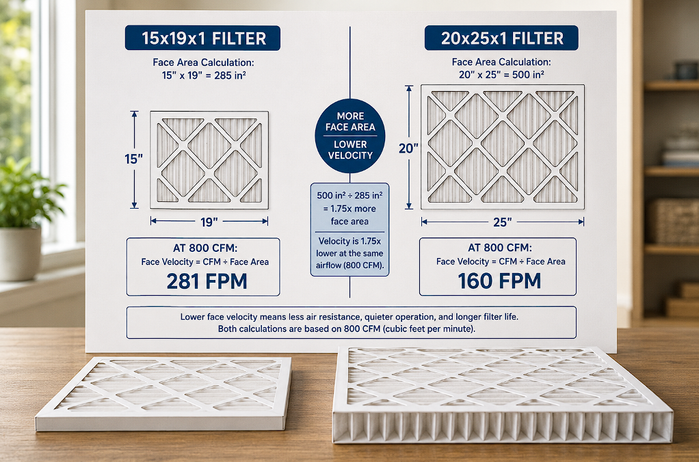
A 15x19x1 has 1.98 square feet of face area, roughly 42% less than a 20x25x1. Pressure drop climbs with air speed through the media, so a rating that passes unnoticed in a large return becomes the restriction in a small one.
The governing number is face velocity: airflow divided by face area. DOE prefers 200 to 400 FPM residentially and treats 500 FPM as the maximum, while Energy Vanguard's rule for high-MERV filters is tighter at two square feet per 400 CFM, or 200 FPM. Run the numbers at the standard 400 CFM per ton, with the 15x19x1 as your only return:
• 1.5 tons (600 CFM): 303 FPM, inside the preferred band but with no margin
• 2 tons (800 CFM): 404 FPM, right at the top of the band
• 2.5 tons (1,000 CFM): 505 FPM, past the maximum desired velocity
• 3 tons (1,200 CFM): 606 FPM, well past it
Neither guideline gets a single 15x19x1 to two tons, and plenty of these slots sit on larger systems. I could not find this arithmetic published for this size, so I worked it out here. Every general MERV guide I checked assumes a 20x25x1, and that assumption makes MERV 13 sound like a free upgrade when here it is a trade.
With more than one return, divide airflow first. Two returns sharing a two-ton load put roughly 400 CFM through each, landing near 202 FPM with room for MERV 13.
MERV 8 vs MERV 11 vs MERV 13 in a One-Inch 15x19x1
In this size the ratings differ less in what they capture than in what they cost in airflow. Every step up adds resistance, and a small slot has no margin to absorb it.
MERV 8 Is the Safe Default
Choose MERV 8 when the 15x19x1 is the sole return on two tons or more, when ductwork is undersized, or when the air handler runs a PSC blower with little reserve.
MERV 11 Is the Balance Point
Under ASHRAE 52.2 it captures more than 65% of particles at 1 to 3 microns and more than 20% at 0.3 to 1 micron, covering dander and fine allergens without MERV 13's jump in resistance, and it stays workable at 300 to 400 FPM with a shorter change interval.
MERV 13 Is Conditional
It reaches beyond 85% at 1 to 3 microns and beyond 50% at 0.3 to 1 micron. EPA recommends it, or as high a rating as your fan and filter slot can accommodate, if the filter is replaced frequently. In a 15x19x1 the slot is the constraint that phrasing points at.
Depth matters as much as the rating, since deeper pleats add media area and lower resistance without changing the number on the box. DOE is also blunt about sourcing, advising you to avoid manufacturers who will not publish static pressure data. California has required pressure-drop labeling since 2019, so read the label edge.
Does MERV 13 Restrict Airflow in a One-Inch Filter?
Yes, and by more than published specs suggest, because those are measured at a standard test velocity rather than the one your slot runs.
Pressure-drop charts are typically published at a nominal 1,000 CFM. On a 20x25x1, with its 3.39 square feet, that comes to roughly 295 FPM; on a 15x19x1 the same airflow produces 505 FPM. Same media, same rating, 1.7 times the velocity, and pressure drop rises faster than velocity does.
You are not choosing between rating labels. You are choosing where on the resistance curve your slot sits.
What happens next depends on your blower. PSC motors cannot adjust speed, so airflow falls off as static climbs; DOE describes a PSC working to roughly 0.5 in. w.c. then giving up, fan still turning but moving little air. ECM motors chase target airflow and work harder instead, and DOE notes burnout is likelier with an ECM. One filter at 0.25 in. w.c. can consume half a PSC system's available static pressure.
How to Check Before You Upgrade
Six steps settle this in under two minutes.
1. Count your returns. If the 15x19x1 is the only one, use full system airflow; if there are others, divide across them.
2. Find your tonnage on the outdoor unit's data plate, then multiply by 400 for design CFM.
3. Divide that CFM by your measured face area in square feet. Under 300 FPM puts MERV 13 in play, 300 to 400 FPM points to MERV 11, and above 400 FPM points to MERV 8 and a conversation about the return.
4. Read the label edge, where pressure drop at a stated airflow says more than the rating.
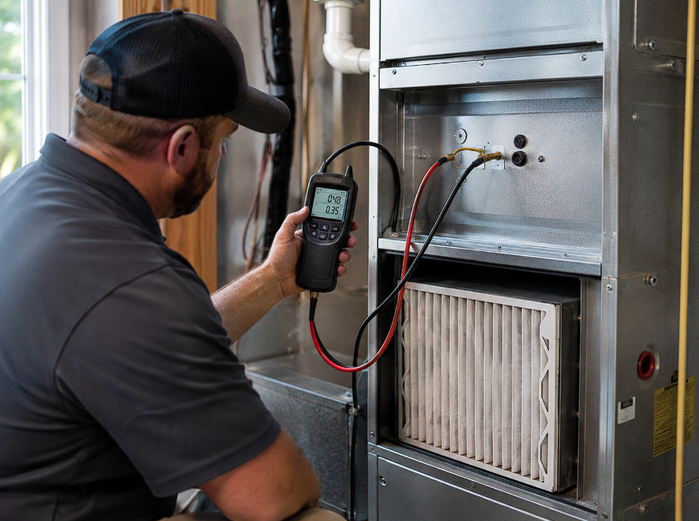
5. Have static pressure measured. A technician adds supply and return static with a manometer, and the total should land at or under 0.4 to 0.5 in. w.c.
6. Shorten the interval if you go higher, to 60 days rather than 90 with MERV 11 or 13, and sooner with pets or heavy pollen.
Related: how often to change your home AC air filter.
When the Fix Is the Slot, Not the Filter
Above roughly 400 FPM, no MERV rating solves the problem. The filter is the symptom, the return is the cause. Three options are worth pricing with a contractor:
• Add a second return. The most effective fix, and it improves comfort and noise too.
• Convert to a deeper media cabinet. A four-inch MERV 13 can present less resistance than a one-inch MERV 11.
• Convert return grilles to filter grilles, the least invasive route when returns are fully ducted.
Swapping ratings inside an undersized slot only spends money on the symptom. See also: filters and air ionizer installs.
Three Things the Spec Sheets Will Not Tell You
Check Whether You Are Running Two Filters in Series
Some homes have one at the air handler and another behind the return grille, and together they stack resistance on a system with no margin. HVAC designer David Butler, in the practitioner discussion on Energy Vanguard's sizing article, is direct: filters in series add unnecessary restriction, so remove one and keep the larger.
Temporary High-MERV During Smoke Season Is a Different Question
If smoke rolls in and you want MERV 13 for two weeks, that same discussion notes temporary duty is unlikely to cause problems, though it does cut sensible cooling capacity. The real risk is a frozen coil, and only on a system already starved for air. Watch for weak airflow at the registers and swap back once the smoke clears.
Replace on Pressure Drop Rather Than the Calendar
Change the filter once its pressure drop has doubled from clean. In a small slot that arrives before the filter looks dirty, and a filter can look filthy while still flowing well.
Essential Resources for Getting Your 15x19x1 Right
Seven references, ordered the way you will need them.
1. Confirm Your Slot Takes This Exact Size Before You Buy
Filterbuy, 15x19x1 Air Filters
Lists actual dimensions alongside the nominal label, the check that matters most in a size where brands differ by nearly an inch, and carries MERV 8, 11, and 13.
2. See What Each MERV Step Actually Costs Your Blower
U.S. Department of Energy, High-MERV Filters
The most complete public reference on the filtration-versus-airflow tradeoff, with the full MERV efficiency table, the static pressure ceiling, and why PSC and ECM blowers fail in opposite ways.
3. Find Out Whether Your Slot Is Simply Too Small
Energy Vanguard, The Path to Low Pressure Drop Across a High-MERV Filter
The source of the sizing rule used here, backed by measured pressure-drop readings from real installations, and the clearest case for why filter area rather than rating decides the outcome.
4. Match the Rating to What Your Household Needs
U.S. Environmental Protection Agency, Guide to Air Cleaners in the Home
Consumer-level guidance on choosing a rating and a replacement interval, and candid about limits: filtration will not solve a mold problem or replace ventilation.
5. Fix an Undersized Return Instead of Fighting It
U.S. Department of Energy, Proper Installation of Furnace and Air-Handler Filters
For readers whose face-velocity math came back high, covering how to add filter surface area through deeper pleats, larger dimensions, or a return grille.
6. Verify an Ionizer or UV Add-On Will Not Emit Ozone
California Air Resources Board, List of Certified Air Cleaning Devices
Relevant to anyone pairing a filter with an ionizer, UV lamp, or precipitator. Note CARB's caveat: certification covers ozone and electrical safety, not effectiveness.
7. Read the Research Behind the Filtration Claims
U.S. Environmental Protection Agency, Residential Air Cleaners: A Technical Summary, 3rd Edition (PDF)
The technical companion to resource 4, covering filtration performance data and how in-duct filtration compares with portable units.
Supporting Statistics
• Americans spend about 90% of their time indoors, where some pollutants run 2 to 5 times higher than outdoors (EPA, Report on the Environment). If the 15x19x1 is your only return, that filter is where whole-house particle removal happens.
• 27.8 million Americans have current asthma, and 42.3% had an attack in the past year (CDC, asthma surveillance data, 2023 NHIS). Two in five are not well controlled, and those homes are where MERV 11 earns its resistance penalty.
• Space heating accounts for 42% of residential energy consumption, with air conditioning adding another 9% (EIA, 2020 RECS end-use results). A restrictive filter stretches runtime on the largest category of home energy use.
Frequently Asked Questions
What Is the Best MERV Rating for a 15x19x1 Filter?
MERV 11 when the slot is one of several returns. MERV 8 when it is the only return on two tons or more, which is the more common situation in this size.
Is MERV 13 Bad for My HVAC System?
Not inherently. EPA says most systems accommodate it as long as the filter gets changed frequently. In a one-inch 15x19x1 serving as the sole return, the slot is the limit, not the system.
Can I Use a 15x20x1 Instead?
No. The extra inch will either fail to seat or bow the frame, and both open bypass gaps. Match your measured housing, and go custom if no stock size fits.
Run the Numbers Before Your Next Filter
Divide your design airflow by 1.98 square feet, and the face velocity tells you what your 15x19x1 can carry. Under 300 FPM puts MERV 13 in play, 300 to 400 FPM points to MERV 11, and anything higher means the return is your real problem. It takes ninety seconds and beats any chart, because it uses your system rather than an average. If the number comes back high, book a static pressure reading before spending more on filters. If you have already measured yours, share the reading in the comments.
Learn more about HVAC Care from one of our HVAC solutions branches…
Filterbuy HVAC Solutions - West Palm Beach FL
1655 Palm Beach Lakes Blvd., Ste 1005 West Palm Beach, FL 33401
(561) 448-3760
https://maps.app.goo.gl/VarpgNZnxuPQuW8A7